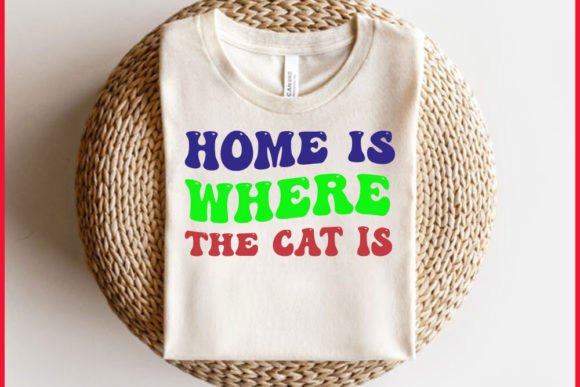
Unique Retro CAT T-shirt Design, I Love
A Designer’s First Look: Charm with Clear Intent
When Unique Retro CAT T-shirt Design, I Love landed in my inbox, I paused—not because it’s flashy, but because it’s quietly confident. The cat sits front-and-center in bold, rounded retro lines: a soft silhouette with expressive eyes, slightly tilted head, and that unmistakable mid-century charm. It doesn’t shout; it winks. As a designer who’s stitched hundreds of motifs onto everything from baby onesies to boutique aprons, I immediately saw its sweet spot: friendly, nostalgic, and effortlessly scalable. This isn’t a design built for maximalist detail—it’s built for readability at 3–4 inches wide, for warmth over precision, and for stitching that feels handmade, not machine-perfect.
How It Holds Up on Real Embroidery Projects
I tested Unique Retro CAT T-shirt Design, I Love on a natural cotton canvas tote bag—my go-to for small-batch craft fair items—and then scaled it down for a lightweight unisex sweatshirt. On both, the shape translated cleanly. The curves stayed smooth, the negative space around the cat’s ears and paws gave breathing room for fill stitch, and the “I Love” text (set in a clean, slightly bubbly sans-serif) held legibility even at 2.5 inches tall. That’s critical for custom apparel where clarity matters more than cleverness.
It shines brightest as a machine embroidery design for lifestyle-focused products: embroidered pillow covers for nurseries, tea towels for cat-loving bakers, or minimalist patches sewn onto denim jackets. I also used it as an applique design on a stretchy baby bodysuit—backed with tear-away stabilizer and stitched with a satin border—and the result felt cohesive, not stiff. For commercial embroidery, it’s low-risk: no tiny interior details that vanish in dense fill, no overlapping letterforms that confuse auto-digitizing software, and no fine linework that frays on thin fabric.
Where to Use It Thoughtfully
That said, Unique Retro CAT T-shirt Design, I Love isn’t universally forgiving. On dark fabrics—especially heavy twill caps—the “I Love” text can soften visually unless you boost thread contrast with bright white or neon pink top thread. On highly textured fabrics like terry cloth or bouclé, the clean lines may blur slightly at the edges; a light cutaway stabilizer helps, but test first. And while it scales beautifully up to 5 inches, avoid shrinking it below 1.75 inches: the inner eye detail and subtle whisker hints start to collapse under standard stitch density.
Curved surfaces like baseball caps demand extra attention too. I hooped a pre-curved cap panel and ran a test stitch—no puckering, but the bottom curve of the cat’s chin stretched slightly. A gentle repositioning (raising the design 1/8" higher on the front panel) solved it. That’s not a flaw—it’s just how retro shapes interact with 3D surfaces. Always check your hoop size and adjust placement accordingly.
What It Adds to Your Handmade Product—and Your Customer’s Experience
This design elevates a simple item into something emotionally resonant. When I stitched it onto a linen kitchen towel as a holiday gift, recipients didn’t just say “cute”—they smiled and said, “That’s *so* me.” That emotional shorthand is gold for Etsy sellers, small shop products, and personalized gifts. It reads as intentional, not generic. It supports brand consistency for makers who lean into warm, analog-leaning aesthetics—think cottagecore bakeries, indie pet shops, or slow-living lifestyle brands.
Visually, it balances well in mockups. In black-and-white printable mockups, the contrast holds. On light fabric, it reads as cheerful; on charcoal or navy, it gains quiet sophistication. That versatility makes it a strong candidate for digital embroidery file bundles or as a standalone design asset in your creative toolkit.
Practical Notes Every Embroidery Designer Should Keep Handy
- Test first—on scrap fabric matching your final product’s weight and stretch.
- Check thread color contrast, especially for the “I Love” text against dark backgrounds.
- Review stitch density before scaling—dense fills work well here, but avoid overloading lightweight fabrics.
- Confirm hoop size fits your intended placement, particularly on curved or narrow items like caps or baby hats.
- Inspect small details at actual stitch-out size—those whiskers and pupils should read clearly, not disappear.
- Try black-and-white mockups to assess value contrast before committing to thread choices.
- Use proper stabilizer: medium-weight cutaway for knits, tear-away for stable wovens, and fusible + tear-away for lightweight linens.
- Verify licensing before selling finished items or bundling the files—this T-Shirt Designs asset is labeled for broad use, but always double-check scope if reselling digitally.
Final Thought: A Design That Serves Its Purpose Well
Unique Retro CAT T-shirt Design, I Love won’t win awards for technical complexity—but it wasn’t meant to. It wins where it counts: in clarity, charm, and real-world adaptability. Whether you’re stitching a single personalized gift or producing 50 embroidered tote bags for your craft business, this Graphics file delivers consistent results without demanding endless tweaks. It respects the craftsperson’s time and the customer’s eye. And in a market flooded with overdesigned, overscaled, overcomplicated motifs, that kind of thoughtful restraint is rare—and valuable.